Almost everyone who lives in an apartment uses the buzzer without knowing what it does. That is fine until it breaks, or until you want it to do something it currently cannot, at which point knowing the mechanism saves a lot of guessing.
The short answer: your building's entry panel makes a phone call, and the door release is triggered by a tone sent back down that call.
What are the parts of a buzzer system?
Four, and they fail independently.
- The entry panel. The box in the lobby with buttons or a screen. It holds a directory: a list of units and, next to each, a number to dial.
- A line out of the building. How the panel places its call. Historically a dedicated copper phone line, increasingly cellular or internet.
- A destination. Whatever that number rings. Traditionally a handset wired inside the unit; on newer systems, a phone number.
- The door release. An electric strike or magnetic lock on the door, wired to the panel, that unlocks when triggered.
Most confusion about buzzers comes from assuming these are one thing. They are not, which is why the door can fail to open on a call you can hear perfectly.
What happens when a visitor presses my unit?
The panel looks your unit up in its directory and dials the number stored there.
That is genuinely the whole first half. There is no clever routing and no central service deciding anything. The panel is a phone that dials one number per unit, and the directory is the mapping.
If the number is right, something rings. If it is a handset in your kitchen, the handset rings. If it is a mobile number, a phone rings. The panel does not know or care which.
How does pressing a key open the door?
The panel listens for a tone on the call and triggers the door strike when it hears the right one.
This is why every intercom asks you to press a specific digit, usually 9 or 6, rather than saying "open". The keypress sends a DTMF tone, which is the same signalling that phone menus use. The panel is listening for that tone for the duration of the call, and when it hears it, it closes the circuit on the door release for a couple of seconds.
Two things follow. The unlock only works while the call is live, and the door relocks on its own. There is no persistent "unlocked" state to forget about.
Why do old buzzers only work when I am home?
Because the number in the directory is a wire to a handset on your wall, and a wire only goes one place.
There is nothing smart to disable and nothing to forward. The system was designed when a household had one telephone, in one room, and someone was usually near it. It has no concept of you being elsewhere, which is why there is no voicemail, no second attempt and no way to reach you at work.
What changed in newer systems?
The destination stopped having to be a handset in the building.
Once a panel dials a phone number rather than a wire, that number can be anything. Point it at a mobile and the buzz reaches you wherever you are. Point it at a service and it can ring several people at once, keep a record, and apply rules.
That is the entire mechanism behind phone-connected buzzers, including ours: not a new panel, not new wiring, just a different entry in the directory. Nothing gets installed and no hardware is swapped, which is also why it does not need building approval or a capital project.
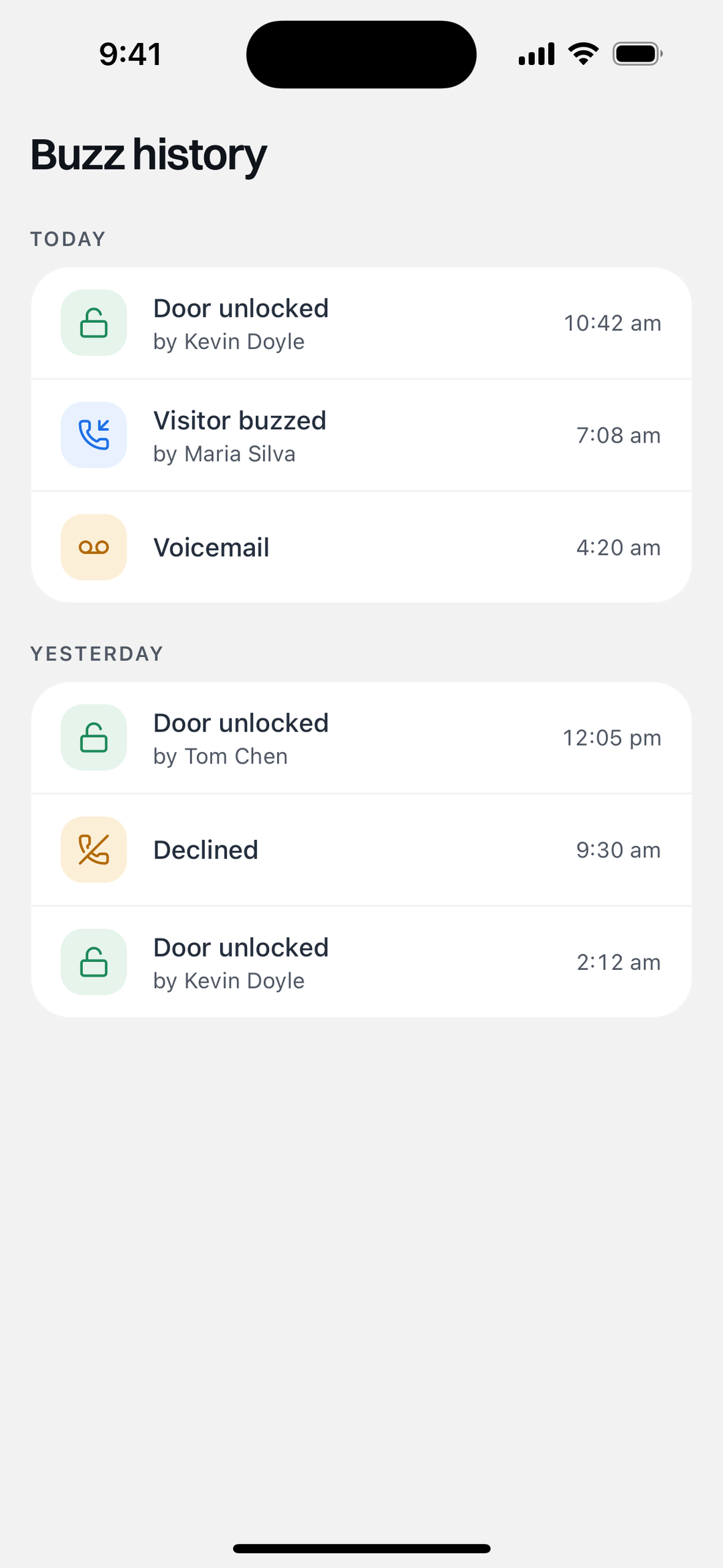
The record is the part people underestimate. A handset tells you nothing after the fact. A call that runs through software can tell you the door was unlocked at 10:42 and by whom.
Is the buzzer connected to my apartment door?
No, and this catches people out.
The buzzer controls the shared entrance: the lobby, the gate, the garage. Your own apartment door is a separate lock with no connection to the intercom. Letting someone into the building does not let them into your unit.
It also means smart locks and smart buzzers solve different halves of an arrival, which is why hosts and residents often end up wanting both.
Why does my building's system feel so old?
Because entry panels have thirty-year service lives and no reason to be replaced until they fail.
A panel installed in the 1990s still does its job: it dials a number and listens for a tone. Buildings replace them when the line underneath dies, which is happening more often now that carriers are retiring copper. The FCC's March 2026 order sped that up, dropping the FCC filing, the FCC's own public notice, and the objection process that went with those notices. Carriers must still publish notice and still owe at least 90 days' direct notice before pulling copper, but that direct notice goes to interconnecting carriers and 911 providers, not to residents — the order is explicit that its copper-retirement rules place no notice obligation on carriers toward end users. Where the retirement also discontinues a service, FCC authorization under section 214 is still required. Entry intercoms are squarely among the systems that stop working when the line goes.
The short version
An apartment buzzer is a phone call and a tone. The panel dials whatever number is listed for your unit, and unlocks the door when it hears the right key pressed on that call.
Everything people want from a "smart" buzzer follows from changing one field: which number gets dialled. If yours currently rings a handset nobody is standing next to, that is the field to change.
Diagnosing a specific fault? Work out what is actually broken. Ready to change the number? The setup takes about two minutes.