If you live in an apartment, the "we missed you" slip is a familiar piece of paper. The driver rang your unit, nobody picked up, and the package went back on the van. Nothing was broken. The buzzer worked exactly as designed. The design is just forty years old.
Why do apartment deliveries fail so often?
Because the buzzer only rings a handset inside your unit, and you are usually not standing next to it.
Across retail and ecommerce generally, between 8 and 20 percent of parcels fail on the first delivery attempt, depending on carrier and geography. Apartments carry their own failure modes on top of that: a unit number that got dropped from the label, a directory panel listing the previous tenant, a lobby door with no code. Each failed attempt costs the carrier around $17.78, which is a large part of why drivers do not linger.
The result is predictable. You get home to a slip, then spend a week arranging redelivery around a job you are already at.
What happens when the buzzer rings and I am not home?
Today, nothing. That is the whole problem.
(If the buzzer does not reach anyone even when you ARE home, that is a fault rather than a design limit. Diagnose it here.)
A traditional intercom is wired to a handset on your wall. If you are at work, on the bus, or three floors down doing laundry, the call has nowhere to go. There is no voicemail, no second ring, no way to say "leave it with the concierge." The driver waits maybe twenty seconds and moves on.
How does a phone-connected intercom change that?
It replaces the handset with your phone, so the call reaches you wherever you are.
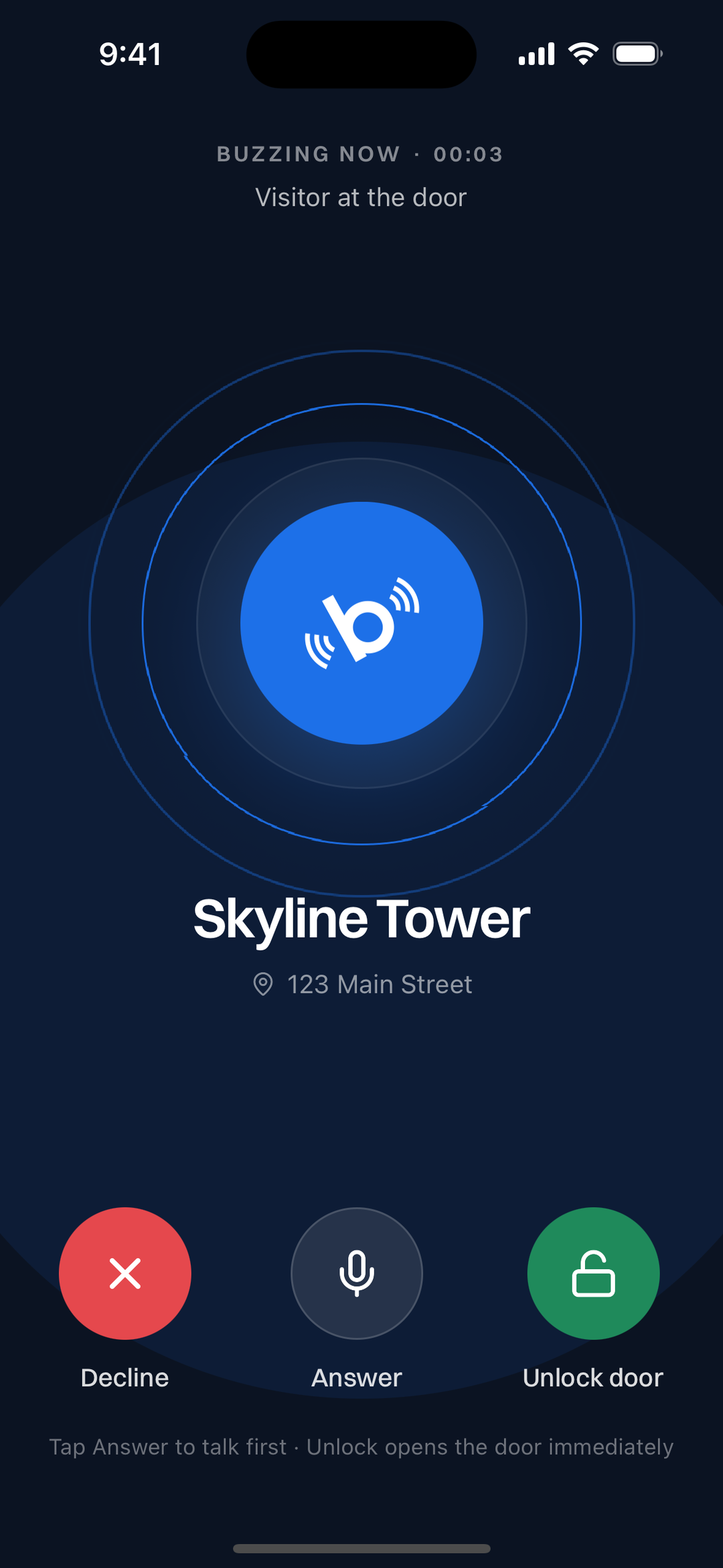
When the driver presses your unit on the panel, your phone rings. You answer, you hear them, they hear you. If it is a delivery you were expecting, you unlock the door from wherever you are standing. If it is someone you do not recognise, you decline and nothing happens.
The important part is that you are talking to the person at the door in real time. You can tell a driver which side entrance to use, or ask them to leave it with the front desk. A lockbox cannot do that. A camera cannot do that.
Do I need to install anything?
No. There is no hardware in this, which surprises people who have priced out a smart intercom before.
The setup is three steps and none of them involve a contractor:
- Get your number. You sign up and receive a phone number of your own for the building's intercom to call.
- Put it on the buzzer. That number goes where your unit's old one is listed in the directory. Nothing is installed and no hardware is swapped.
- Answer from anywhere. The buzzer now rings your phone.
Because you are only changing a number in a directory, you do not need your landlord's permission to modernise your own unit. The panel in the lobby stays exactly as it is. We wrote the setup up in more detail in Install a Phone-Connected Apartment Buzzer in Under 10 Minutes.
Does this help with package theft?
It helps with the part of the problem you can actually control, which is whether the package makes it inside the building.
Package theft is still enormous. SafeWise's 2025 report puts it at 104 million packages stolen in the United States over twelve months, with 31 percent of Americans reporting a theft in that window. Encouragingly, that figure is down about 13 percent from 120 million in 2023.
A parcel left in a lobby, a mailroom, or with a neighbour is a parcel that is not sitting in a hallway or on a stoop. Being able to answer the buzzer is what gets it there. It is not a vault, and we are not going to claim otherwise, but "inside the building" beats "outside the building" on every measure that matters.
What about roommates and family?
Everyone in the unit can be on the same buzzer, by name.
You add the people who live with you, and their phones ring too, so whoever is free answers. They can answer and unlock, but they cannot change settings or invite anyone else. When someone moves out you remove them, and their access ends immediately. You can read the full list at any time, which is more than can be said for a copied key.
Every buzz your apartment receives is kept and searchable, so "did anything come on Tuesday" is a question with an answer.
Is it worth it if I only order a few things a month?
That depends on what a missed delivery costs you, and the honest answer is that it is not only about parcels.
The same call reaches you when a friend arrives early, when a contractor needs in, when a food order is downstairs, or when someone you do not know is trying doors. Deliveries are the most frequent case, not the only one. Current pricing is on the Buzz Me Up app page.
The short version
A missed delivery is not a failure of the courier or of you. It is a failure of a system that assumes somebody is always home, which stopped being true decades ago. Moving the call to your phone fixes the assumption rather than working around it, and it does so without a contractor, a new panel, or a conversation with your landlord.
Get Buzz Me Up on iPhone or Android, or read how smart buzzers are changing apartment living.