The apartment intercom is one of the last pieces of household infrastructure that assumes you are home. Almost everything else adapted: the thermostat, the lights, the doorbell on a house. The buzzer in an apartment lobby is still a wire to a handset on a wall, waiting for someone to be standing next to it.
That single assumption causes most of what residents find annoying about their building's entry system.
What is actually wrong with a traditional buzzer?
It has exactly one destination, and you are usually somewhere else.
There is no second ring, no message, no way to reach you at work. A courier gets about twenty seconds before moving on, and across retail generally 8 to 20 percent of parcels fail on the first attempt. It also has no memory: you cannot find out who buzzed while you were out, or who let them in.
And it has no notion of people. A unit has a handset, not a household. Everyone who lives there shares one point of contact, and nobody has their own.
What changes when the buzzer rings your phone?
The call finds you, and it starts keeping a record.
The mechanism is simpler than it sounds. Your building's panel already dials a number listed against your unit. Point that entry at a number issued for your phone instead of the handset, and the buzz becomes a call you can take anywhere. Nothing in the lobby is replaced.
Four things follow from that, and they are the real change:
The call reaches you anywhere. At work, on a train, in another country. You talk to whoever is at the door and open it if you want to.
A household stops being a single handset. Everyone who lives there can be on the buzzer by name, with their own access. Whoever is free answers.
Entry becomes a list, not a key. You add people, you remove them, and removal takes effect immediately. Nothing is copied and nothing is left circulating.
It remembers. Every buzz is recorded and searchable.
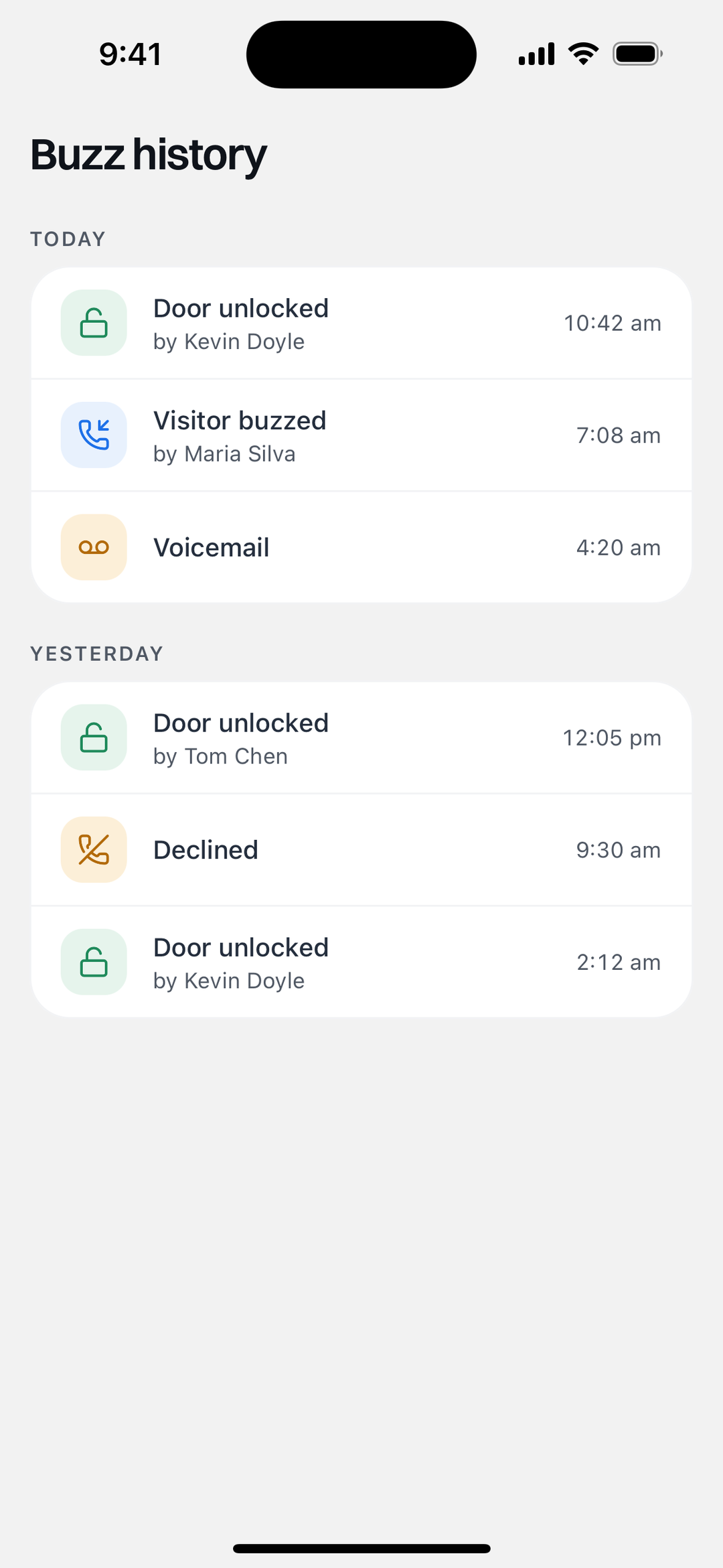
That last one is quietly the biggest shift. A handset tells you nothing after the fact. A history tells you the door was unlocked at 10:42 and by whom, that a buzz at 9:30 was declined, and that someone left a voicemail at 4:20 when nobody picked up.
Is it secure to open a door from my phone?
It is a different security model, and on most measures a stricter one.
The honest comparison is not against a vault, it is against what buildings do now: a handset anyone in the apartment can press, and a key that has been copied an unknown number of times over an unknown number of tenancies.
Against that, you get a named list you can read, roles that limit what people can do (someone you add can answer and unlock, but cannot change settings or invite anyone else), removal that takes effect immediately, and a record of every entry. Access codes can be limited to a window, so they work between a start and end time and do nothing outside it.
Can I see who is at the door?
No, and it is worth being straight about this: it is a voice call, not video.
You hear the person and they hear you. There is no camera, because the system works through the intercom your building already has rather than replacing it with a video panel. If you want video at the lobby door, that is a building-level capital project and a different product.
What you get instead is conversation, which is more useful than it sounds. You can ask a courier to leave it at the desk, or ask an unexpected visitor who they are here for.
Who does this actually help?
Anyone whose life does not fit inside the apartment during business hours.
- People who order things. Deliveries are the most common trigger. Fixing missed deliveries covers that case in detail.
- Short-term rental hosts. The lobby door is the gap self check-in does not cover. We wrote that up in smart buzzer solutions for hosts.
- Shared households. Roommates who each want their own access rather than a shared handset, and a clean way to end it when someone moves out.
- Anyone in a building with a broken or wrong directory entry. If your panel still lists a previous tenant, changing the number is the fix. Not sure which fault you have? Work out what is actually broken first.
What about my building, not just my unit?
Some things need the building itself, and it is worth knowing which.
Everything above works for your own unit without asking anyone. A few capabilities are building-scoped by nature: visitor parking permits and booking shared amenities need the building to be set up, because those are the building's resources rather than yours. If yours is not, that is a conversation with whoever manages it.
Is it a big project?
No. Setup is getting a number and having it listed against your unit, which we walk through in Install a Phone-Connected Apartment Buzzer in Under 10 Minutes.
Nothing gets installed, no hardware is swapped, and because you are only changing a directory entry you do not need your landlord's permission to modernise your own unit.
The short version
Buzzers did not get worse. Our lives moved and the buzzer did not. Moving the call to the device you already carry fixes the assumption at the root, and it turns out most of the frustration people have with apartment entry was downstream of that one thing.
If you want the mechanism rather than the pitch, How Do Apartment Buzzer Systems Actually Work? takes the whole thing apart.
Get Buzz Me Up on iPhone or Android, and see current pricing on the app page.